The High Street as Stable: Lauriston’s December Window Nativity
December in Edinburgh can feel like a competition between light shows. Lauriston’s answer is quieter. It is a nativity trail that begins at Sacred Heart, slips into shop windows, and asks you to walk a few familiar streets with your eyes open. There is no ticket, no turnstile and no app. A paper map, a decent pair of shoes and perhaps a torch for the darker afternoons are enough.
A story told in fragments
The trail is not an exhibition in the usual sense. Nobody has hung a single narrative in one room. Instead, a dozen or so businesses near the church each hold one piece of the Christmas story: an angel above a florist’s bucket, a shepherd in a barber’s window, a manger tucked between books and a coffee grinder. You have to walk to join the dots.
That is the point. The organisers, a loose group of parishioners and traders, describe it as a way of making the high street feel like a shared room. You do not need to be a regular churchgoer to follow it. You do not even need to be particularly good at walking in a straight line. The map is forgiving, and so are the shopkeepers.
The route, roughly
Start at the steps of Sacred Heart on Lauriston Place. A paper map is usually left in the church porch and in participating windows, though the trail is simple enough to follow without one. From there, the route curls through the streets behind the church and returns by a different way, so you are not simply retracing your steps.
- Lauriston Place. The first window sets the tone. A barber has given over a corner of his display to a small wooden shepherd, slightly chipped at the crook. It is not glossy. It looks like something that has been carried between houses for decades.
- Lady Lawson Street. A florist places an angel among eucalyptus and winter greenery. The figure is barely visible at first, which is half the pleasure. You have to lean in.
- West Port. A café puts Mary and Joseph beside a tray of mince pies, with a hand-lettered sign that reads: ‘Room made ready.’ It is the most Edinburgh-friendly version of the inn you will see all month.
- Grassmarket. A bookshop arranges a stable from hardbacks and paperbacks, with a small carved baby at the centre. The books are not for sale as a set. They are simply a hillside for the evening.
- Victoria Street. A vintage shop gives the wise men a spot among brass candlesticks and old postcards. Their gifts look suspiciously like small boxes of fudge.
- Back towards Lauriston. The last stop is the church porch, where a lantern and a guest book wait. You do not have to sign it. But plenty of people do.
The whole walk takes about an hour if you stop, and twenty minutes if you march. Most people take the longer version. The pavements are manageable for buggies and wheelchairs, though some of the side streets are cobbled and uneven. Daylight is best for seeing the details; after dark, the windows take on a different, more candlelit feel.
The barber, the bookseller and the baby
The trail works because it is small. One trader told me he likes the fact that people stop. ‘You get folk who have walked past for twenty years and never looked in,’ he said. ‘Now they peer through the glass and wave.’ He has been asked, more than once, whether the shepherd is for sale. He says no, firmly, but politely.
A bookseller on the Grassmarket said the hardest part was making a stable look like anything other than a pile of unsold stock. ‘We tried stacking them in a triangle,’ she said. ‘It looked like a pyramid. Then someone brought in a little wooden baby and it all made sense.’
Frances, a parish volunteer who helps co-ordinate the trail, says the aim is not to compete with the city’s bigger Christmas attractions. ‘It is a nudge,’ she says. ‘Look left. Look up. Say hello.’ She admits that the map has been redrawn more than once after a shop changed hands or a window was repainted. That is part of the charm. The trail is not fixed. It belongs to the street.
Why shop windows work
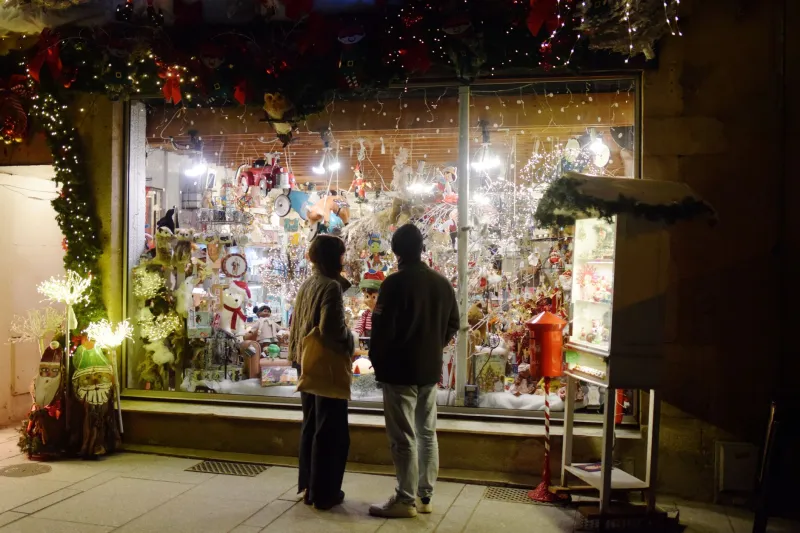
A church Nativity set is usually arranged in one place, with figures facing the same way and a neatness that can feel a little stiff. A shop-window trail does something different. It puts the story where people already are: beside the bus stop, above the queue for coffee, next to the dry cleaning. It makes the Christmas story look like it has errands to run.
That is not a new idea, but it is a useful one. For visitors, it offers a reason to wander beyond the obvious landmarks. For neighbours, it turns a familiar walk into a small treasure hunt. For children, it is a chance to count shepherds and spot the oddest angel. For everyone else, it is a reminder that a high street is not just a row of transactions. It is a place where people can put something on display simply because they want to share it.
Practical notes for the walk
The trail usually runs from the first day of December through the first week of January. This year, look for it from 1 December 2026. It is free, and there is no need to book. Most windows are visible from the pavement, but a few are tucked inside shop doorways, so keep an eye out for small signs.
If you go with children, the map is easy enough to follow without a phone. If you go alone, it is a gentle way to spend a lunch hour. If you go with a neighbour, it gives you something to talk about that is not the weather. The organisers ask only that you respect shop hours and do not tap on glass after closing time. The figures are small, but the welcome is meant to be genuine.
By the time you reach the church porch again, the walk has done something quietly clever. It has turned Lauriston into a stable, the shopfronts into a story, and an ordinary December afternoon into a shared act of looking. You do not have to buy anything. You just have to show up and pay attention.