Crossing the Threshold: A First-Timer’s Sunday at Sacred Heart
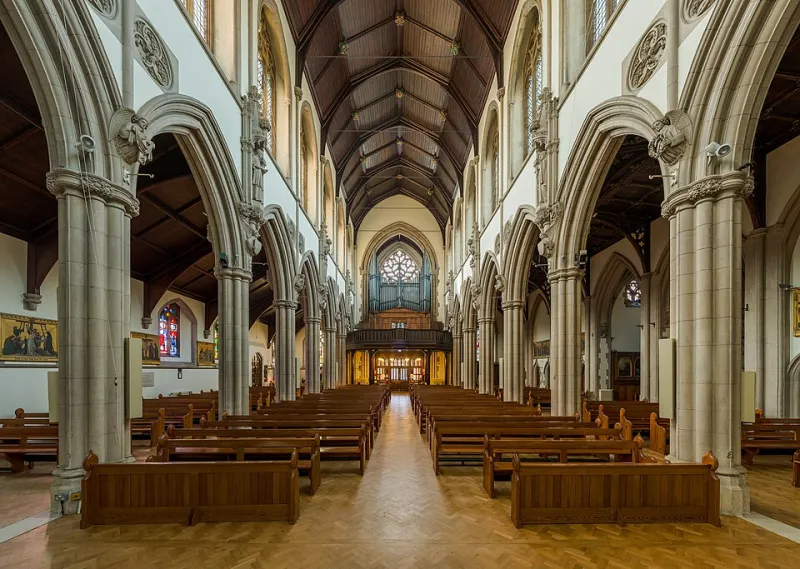
Photo: Diliff, CC BY-SA 3.0, via Wikimedia Commons
Standing outside Sacred Heart on a Sunday morning, you can learn a lot from the pavement. People arrive in ones and twos, some in smart coats, some in walking boots, some carrying a child and a bag of raisins. Nobody looks like they are auditioning for a role. That is the first thing worth knowing: the front door is not a test.
This guide is for anyone who has hovered at the edge of the porch, or walked past on a weekday and wondered what the inside feels like when it is full. It is not a history of the building, and it is not a instruction manual for being a Catholic. It is simply a neighbour’s account of what happens before, during and after a Sunday Mass at Sacred Heart, and how to make the morning easier on yourself.
Before you arrive
Check the current Mass times on the parish website or the noticeboard by the door. Times can shift around holidays and school terms, and a quick look saves a wasted trip. If you are nervous, aim to arrive about ten minutes early. That gives you time to find the entrance, read the notices and choose a seat without feeling watched.
There is no dress code. Wear what you would wear to a neighbour’s birthday lunch. You do not need to bring a prayer book, a rosary or cash for a ticket. Service sheets are usually available at the door, and everything else is optional. If you have mobility needs, tell a steward at the entrance; they are there to help with seats, aisles and accessible routes, not to quiz you on your credentials.
At the door
Someone will probably say hello. It might be a greeter, a steward or simply a regular who has taken up a post by the handle. You can say ‘I’m just visiting’, or ‘I’m not sure what I’m doing’, or nothing at all. All three are acceptable. If holy water is offered, you can take it or pass. Nobody is keeping score.
Once inside, pause at the back if you need a moment. The building can feel grand from the street, but the back of the church is a good place to get your bearings. Look for the service sheets, the notices and the collection baskets. Then choose a seat.
Where to sit
Contrary to what your nerves may tell you, the back rows are not reserved for regulars. They are often the most sociable part of the church. The side aisles are useful if you want to slip out quietly, and the middle seats are fine if you want to see what is going on. There may be marked seats for particular reasons, but most pews are open.
If you arrive late, do not hover in the porch feeling guilty. Slip in at the back and sit down. If you need to leave early, choose an aisle seat near the door. Nobody will chase you down the steps.
During Mass
The shape of a Sunday Mass is fairly steady: a welcome, readings from the Bible, a homily, prayers, the sharing of the Eucharist, and a blessing at the end. You do not need to know the responses. You can follow the service sheet, listen, or simply sit quietly and take it in.
There will be standing, sitting and kneeling. Follow along if you are comfortable, or stay seated. No one minds. Singing is optional too. The words are usually printed or projected, and a quiet voice is perfectly acceptable. If you are not sure about the collection, know that it is not a ticket price. Give if you wish, or pass the basket along.
The Sign of Peace can be the most awkward moment for a first-timer. A handshake, a nod or a small wave all work. You do not have to embrace anyone. If you are not receiving Communion, you can stay in your seat, or go forward with your arms crossed for a blessing. Both are normal. Nobody will ask for your membership card.
The quiet exit
If you need to leave early, do it during a hymn or after Communion. Slip out with a nod to the steward. There is no need to explain yourself. If you stay to the end, the last blessing and the final hymn are your cue. Some people leave straight away; others linger in the porch. Both are fine.
After: tea and the hall
Most Sundays, tea and coffee appear in the hall afterwards. Follow the crowd, or ask someone at the door. You may be offered a biscuit and a name tag, though not necessarily in that order. You may be asked where you are from or how you found the church. These are neighbourly questions, not an application form.
If you would rather not stay, a nod at the door is enough. If you do stay, you can sit at the edge of a table and simply listen. Parish life is made of small, unglamorous conversations about buses, weather, grandchildren and who is making the soup next week.
The small signals
A parish feels less like an institution when you notice the small signals: a service sheet folded for someone with cold hands, a steward moving a chair without being asked, a notice about a food bank collection, a regular who always sits in the same spot but never minds sharing a pew. These are not secret codes. They are housekeeping. They are also the reason the room can feel like a neighbour’s front room, even when the ceiling is high and the windows are stained glass.
The hardest part is usually the handle. After that, it is just Sunday.