A Handwritten Advent: The Card Table That Keeps Sacred Heart in Touch
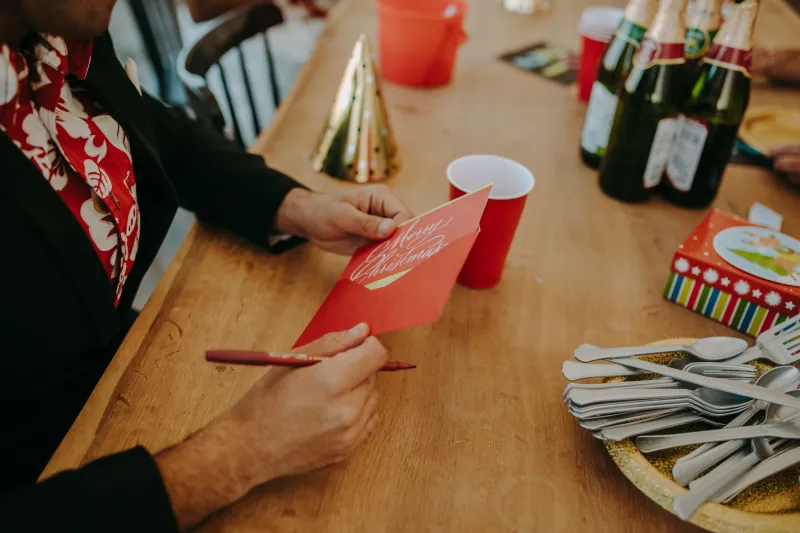
There is a particular sound that arrives at Sacred Heart in late November. Not the organ, not the kettle, not the shuffle of coats before the back doors open. It is the sound of a biro being tested on the corner of an envelope. A small scratch, a pause, then the proper business of writing.
The Christmas card table is not a grand operation. It appears in the hall after Sunday Masses, usually from the first Sunday of Advent — which falls on 29 November in 2026 — and stays put through the middle of December. There are stacks of cards, a few pens that actually work, a tin of stamps, and a list or two of names. Some years there is a plate of biscuits within reach. It is modest, slightly chaotic, and entirely in keeping with a parish that has always done its best work at close quarters.
What actually happens at the table
The table exists because Christmas, for all its noise, is a season when people quietly fall off the map. The housebound neighbour who used to be at the back of the church. The parishioner now living in a care home across town. The volunteer who spent years setting out chairs and is now, for one reason or another, not able to. The friend who has moved to Fife and means to visit but hasn’t yet.
Volunteers keep a working list, drawn up with the parish office and the folk who visit people during the year. Names are added, crossed out, added again. It is not a mailing list in any formal sense. It is closer to a memory aid — a way of making sure that the people who are easily forgotten in December are not.
Anyone can sit down. That is the point. You do not need to know the whole list, or commit to a shift, or be good at art. You take a card, you take a name, and you write. Some people do one. Some do fifteen in a single sitting and then apologise for hogging the good pen.
The list is not the point — but it helps
There is a temptation to treat this as a box-ticking exercise: card written, name accounted for, job done. The volunteers who run the table are gently resistant to that. The list is a starting point, not a target. If you know someone who would be glad of a card and isn’t on it, add them. If you have walked past a neighbour’s door in Lauriston or along the Meadows and thought, I haven’t seen them in a while, that is exactly the sort of person the table is for.
The cards themselves are ordinary. Boxes from the high street, leftovers from last year, the occasional handmade effort that leans heavily on glitter. Nobody is judging. The table has seen more than one card with a slightly wonky robin and a message that simply says: thinking of you. Those are often the ones that get kept.
What makes a good handwritten note
This is the part people worry about. Standing in front of a blank card, pen hovering, wondering what on earth to say to someone you barely know.
The answer, according to the regulars, is: less than you think. A good note is short, specific and signed. “Thinking of you this Advent” is fine. “I hope the new flat is warm and the kettle is unpacked” is better, because it is particular. A line about the weather, the state of the Meadows, or the fact that the church bells were slightly out on Sunday is plenty.
What matters more than the wording is the hand. A card that has been written by a person, rather than printed by a machine, carries something extra. It says: someone sat down. Someone thought of you. Someone took twenty minutes they did not strictly have.
Avoid the urge to over-explain. You do not need to fill the card, and you certainly do not need to apologise for not writing sooner. A brief, warm message beats a long, anxious one. And if you are writing to someone you have never met, keep it simple — a greeting, a wish for a peaceful Christmas, and your first name. That is enough.
Why the table matters more than the cards
The cards go out in the post, or they are hand-delivered by volunteers doing a loop of the parish on a dark Tuesday evening. They end up on mantelpieces and windowsills. Some are read twice. A few, inevitably, are kept until Easter.
But the real work happens at the table itself. It is a place where people sit next to someone they do not know and discover a shared name on the list. Where a younger parishioner asks an older one how to spell a street. Where someone mentions that the neighbour two doors down has been unwell, and someone else says they will add them. It is a small, unglamorous sorting office for neighbourliness.
That is why it belongs in the life of Sacred Heart as much as the carol singing or the crib. It is not really about cards. It is about the habit of noticing. The table exists for a few weeks each December, but the list of names it produces is a reminder of something the parish is meant to be doing all year: keeping an eye out, and letting people know they are not forgotten.
If you are passing through the hall after Mass this Advent, pull up a chair. There is a pen somewhere, and a name with your handwriting’s name on it.